

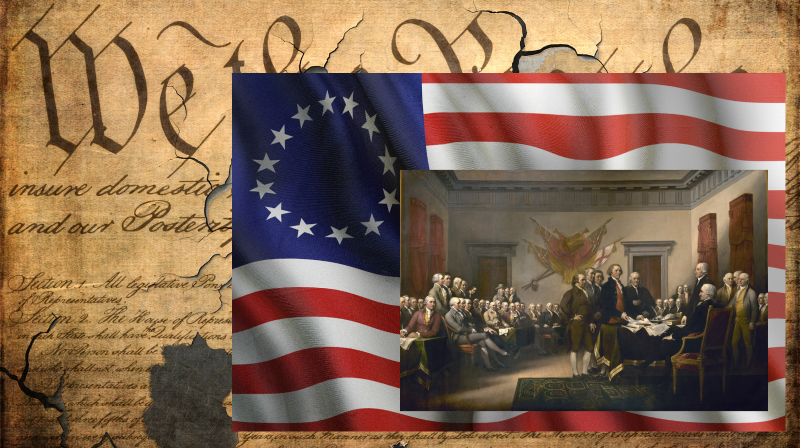
Independence Day is just a few days away, and many will celebrate America's 250th anniversary with parades, carnivals, food, fun, and fireworks. I think what's often left out is what's actually being celebrated. These days too many people look forward to a day off from work, food, and entertainment without even taking one single moment to reflect on the why. It's become like Christmas. We enjoy all of the celebrating, but by-pass what's at the heart of the holiday.
July 4, 1776 wasn't a holiday. There wasn't the smell of burgers on the grill. No lawn chairs. No sparklers keeping little hands entertained while parents reminded everyone to "be careful." There wasn't a parade coming down Main Street or a patriotic playlist strummed by the local orchestral quartet. It was a day when about 49 delegates met is a hot room in the Pennsylvania State House in Philadelphia and sat and sweated while The Declaration of Independence was discussed and finally adopted. Oh...you thought it was signed on the 4th? Uh...no. That didn't happen until August 2 when roughly 56 delegates signed, and the remaining 6 men signed later in the year and into late January 1777.
I bet you weren't aware of that.
Happy Independence Day.
We celebrate the Fourth every year, but somewhere along the way we've boiled the whole thing down to fireworks and bar-b-que. That's not necessarily a bad thing—I happen to like both—but if we're honest, most of us couldn't tell the story behind the day without dusting off memories from high school history class.
When you think about it that's a shame, because history left out some of the best parts.
When people hear "Declaration of Independence," they usually picture one thing: fifty-six men signing a piece of parchment.
Technically, that's true.
But it wasn't just a piece of paper.
It was a death warrant if things went sideways.
King George III wasn't going to read this document and say, "Jolly good opinion, chaps. Carry on."
The signers knew exactly what they were doing. Under British law, declaring independence was treason. The punishment could be hanging. Their property could be confiscated. Their businesses could be destroyed. Their families could be left with nothing.
Yet one by one, they signed anyway.
These men weren't a bunch of mercenaries. They were lawyers, merchants, farmers, doctors, businessmen, judges, and landowners. Many were already successful. They had comfortable lives, respected careers, and every reason to avoid making waves. Yet, they chose to pledge, as the Declaration famously states, "their Lives, their Fortunes and their sacred Honor."
That wasn't flowery language.
That was the risk assessment.
History has a funny way of making success look inevitable. We know America wins because...well...here we are. But imagine being one of those men in 1776. You don't know how the story ends. For all you know, the whole thing falls apart in a week, and you're arrested and handed a one-way ticket to the gallows.
Don't get me wrong. Some did pay dearly. Several had homes occupied or destroyed by British forces. Others saw businesses collapse, fortunes disappear, or spent years constantly moving to avoid capture. Five signers were captured by the British during the war. Nine died before the war was over. Victory was never guaranteed.
And yet, remarkably, they weren't the only heroes.
Not even close.
While those fifty-six men were making history with a quill pen, others were doing extraordinary things that rarely make it into school textbooks.
Take the spies.
If Hollywood had written these stories, and they have, we'd probably complain they sounded unrealistic. Remember that there's some truth in all fiction.
General George Washington understood something many military leaders of his day did not: good intelligence wins wars. So he quietly supported an organized spy network known today as the Culper Spy Ring. It was very successful providing crucial information to help the war effort.
Anna Strong was a member of the Culper Spy Ring. To everyone else, she was simply hanging laundry outside her home. To American spies...her clothesline was a code. A black petticoat hanging on the line, followed by a certain number of white handkerchiefs, could signal where secret messages had been hidden.
Imagine British soldiers casually riding past thinking, "Lovely day for laundry." (Ha! They were ogling the unmentionables.) Meanwhile, an entire intelligence operation was unfolding right under their noses.
Then there was Hercules Mulligan. He wasn't a soldier. He was a tailor. British officers loved ordering custom uniforms from him, which meant they talked...a lot. While measuring sleeves and discussing waistlines, Mulligan quietly collected military information and passed it along to Washington.
Turns out loose lips don't just sink ships. Sometimes they lose wars.
And then there's It was the hill patriots pledged to die on if need be..
British officers actually held secret meetings inside Lydia Darragh's Philadelphia home. They believed they could speak freely because they assumed the quiet Quaker woman wasn't paying attention.
She was.
One night she overheard plans for a surprise British attack. The next morning she convinced the soldiers she needed to leave the house to buy flour. Instead, she walked through enemy lines to warn the Continental Army.
Talk about a grocery run with purpose.
The women of the Revolution deserve far more credit than they usually receive. Sure, many cooked meals, mended uniforms, and cared for families while husbands were away fighting, but they also carried messages, smuggles supplies, gathered intelligence, and even picked up muskets and fought the British.
One of the most remarkable stories belongs to Deborah Sampson. She disguised herself as a man and enlisted in the Continental Army. During one battle she was wounded by musket fire. Afraid army doctors would discover she was a woman, she reportedly removed one of the musket balls from her own leg. I don't know about you, but I negotiate with myself before pulling out a splinter.
There are so many stories that have been passed down through the generations of events that were never recorded in books.
Remember the Boston Tea Party? Most of us know about the patriots that dressed up in Native American clothing and dumped three shiploads of into Boston Harbor. Well, according to several accounts, when one participant tried to pocket tea for himself, the others made him throw it overboard. The message was clear. This wasn't looting. It was protest. Even in rebellion, there were rules.
It's been said that Benjamin Franklin, at seventy years old, after signing the Declaration, he reportedly looked around the room and quipped, "We must all hang together, or assuredly we shall all hang separately." Only Benjamin Franklin could make everyone laugh while reminding them they might all end up on the gallows. That's courage mixed with just the right amount of sarcasm. Maybe that's one reason history remembers him so fondly.
The more you read about the American Revolution, the more you realize it wasn't won by famous names alone. It was won by farmers who left their fields. Blacksmiths who made weapons. Teenagers who carried messages. Mothers who kept families alive. Tailors who listened carefully. Women hanging laundry. People whose names we'll probably never know. Every one of them decided freedom was worth risking comfort.
Some risked everything.
This year, when the fireworks begin, take a moment before the first boom echoes across the neighborhood. Remember that those bright explosions celebrate people who never saw fireworks honoring them. They simply hoped there would still be an America. They didn't know if the Revolution would succeed. They didn't know whether history would call them heroes or traitors. They only knew that some things were worth standing for, even when the outcome was uncertain. That's a lesson that hasn't gotten old in 250 years.
So enjoy the burgers. Wave the flag. Cheer when the sky lights up. But somewhere between the potato salad and the grand finale, remember the tailor, the woman hanging laundry, the seventy-year-old making jokes about the gallows, and fifty-six ordinary men who turned one piece of paper into one of the most powerful documents the world has ever known.
Now that's something worth celebrating.
Happy Independence Day from all of us at Cowchtalk.
Coffee on. Chaos Managed. ☕

Add comment
Comments