

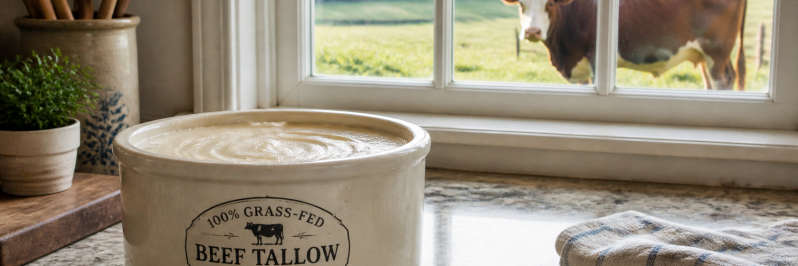
Long before grocery store shelves were packed with cooking oils, skincare products, candles, and enough cleaning supplies to make your head spin, there was a rather unassuming household staple that did a little bit of everything. It wasn't fancy, it wasn't marketed by a celebrity, and it certainly didn't come with a beautifully designed label. It was tallow. And believe it or not, this humble animal fat helped keep households fed, clean, lit, and running for centuries.
Let's take a little trip back in time. Not too far, mind you. We're not going to make you churn butter, fetch water from a well, or spend your afternoon trying to figure out how to get the wrinkles out of a bedsheet without an iron. Does anybody iron bedsheets these days?
We're talking about a time when people had to be a little more resourceful with what they had. There wasn't a big-box store around every corner, Amazon wasn't delivering a replacement for something you ran out of before breakfast, and if you needed something, you either made it, traded for it, or figured out how to do without it.
One of the things people understood particularly well was that very little needed to go to waste. When an animal was butchered, the meat wasn't the only valuable part. Hides, bones, organs, and fat all had useful purposes. And that brings us to today's subject: tallow.
So, What Is Tallow, Anyway?
Before we get too far into the history, let's establish what we're talking about.
Tallow is rendered animal fat, most commonly from cattle. The word rendered simply means the fat has been slowly heated until it melts, separated from the solid tissue and impurities, and strained. Once cooled, it becomes a firm fat with a consistency somewhat similar to shortening.
Traditionally, the preferred source was suet, the firm fat surrounding the kidneys and other internal organs of cattle. (Yeah...I know...it sounds a bit gross.) It was particularly prized for its quality and consistency.
And no, it isn't simply the grease left in the bottom of your frying pan after cooking a pound of hamburger. There's a difference between properly rendered tallow and leftover cooking grease, and that's a discussion saved for another blog.
For now, just remember that tallow was a valuable resource, and people found an impressive number of ways to use it.
The Original Multi-Purpose Household Product
If there's one thing our ancestors understood, it was getting their money's worth.
Today, we have a separate product for practically everything. There's hand soap, body wash, shampoo, conditioner, face moisturizer, body lotion, furniture polish, leather conditioner, and enough specialty cleaning products to require their own cabinet. Look in the cabinet under your kitchen sink if you're in doubt.
Back then? People were considerably less interested in having 37 different products under. It was the one-and-done generation.
Tallow was one of those ingredients that could serve multiple purposes, and that made it particularly valuable.
Let's start with the kitchen.
Cooking with animal fats was commonplace long before vegetable oils became household staples. Tallow was used for frying, roasting, baking, and preparing all sorts of foods. It could be stored for later use and was especially useful because it remained relatively solid at room temperature.
And if you've ever wondered how people managed to cook without a bottle of vegetable oil sitting beside the stove, well, they didn't necessarily need one. Animal fats such as tallow and lard were everyday cooking ingredients, and in many ways a better option.
Tallow was particularly useful for frying because of its ability to withstand relatively high cooking temperatures. It also contributed a rich flavor to food.
In fact, beef tallow has a little piece of modern fast-food history attached to it. McDonald's originally cooked its famous French fries in beef-tallow-based frying fat. Sadly, the company eventually changed its frying formula in the 1990s, but those original fries became legendary among people who remember them.
So, the next time someone looks at you funny for mentioning beef fat as a cooking ingredient, remind them that it once helped make one of America's most recognizable French fries.
You're welcome.
Let There Be Light!
Here's something we don't often think about when we flip a light switch: lighting a home used to require considerably more effort than finding the switch on the wall.
Before electricity became commonplace, people relied on candles, oil lamps, fireplaces, and other sources of illumination. And tallow played an important role in providing light.
Tallow candles were commonly made by dipping a wick repeatedly into melted fat, allowing each layer to cool before adding another. The process was repeated until the candle reached the desired thickness. Candles could also be made using molds.
It was practical, relatively inexpensive, and made use of an available resource.
Of course, tallow candles weren't exactly the modern equivalent of a lovely scented candle from your favorite home décor store. They could produce smoke and an unpleasant odor, particularly when the quality of the fat wasn't ideal.
But when the alternative was sitting in the dark, people weren't terribly concerned about whether their candles smelled like fresh linen or vanilla bean.
They just wanted to see what they were doing!
Getting Clean Before the Soap Aisle Existed
Now we're getting into something particularly interesting.
Tallow was also an important ingredient in traditional soapmaking. In fact, animal fats have been used in soapmaking for centuries.
The process involved combining fats with an alkaline substance, traditionally obtained from wood ash, to produce soap through a chemical reaction called saponification.
Don't worry. We're not going to turn this into chemistry class. Nobody needs a pop quiz today.
The important thing to understand is that animal fats, including tallow, were useful ingredients for making soap. Tallow-based soaps were valued for producing firm, durable bars with a creamy lather.
And unlike today, when you can wander down a grocery store aisle and choose between approximately 400 varieties of soap, people often made their own using ingredients they could obtain locally.
It wasn't necessarily glamorous, but it got the job done.
Interestingly, soapmaking was often a seasonal household activity, with families saving fats and other materials until they had enough to make a batch. It was another example of making the most of available resources rather than running to the store every time something ran out.
More Than Just Food and Household Necessities
By now, you're probably beginning to see why tallow was such a useful commodity.
But its usefulness didn't stop at cooking, candles, and soap.
Tallow also found its way into leather care and other practical applications. Animal fats were used in various traditional preparations to condition leather, help protect materials from moisture, and maintain equipment.
Think about the number of things people depended on that required regular maintenance: leather footwear, harnesses, saddles, tools, and other equipment. Taking care of those items was important because replacing them wasn't as simple as adding something to an online shopping cart.
Tallow was also used in certain traditional ointments and skin preparations. People had long relied on animal fats as a base for preparations intended to soften and protect the skin.
And that's an interesting little detail because it's one of the reasons we're seeing renewed interest in tallow today.
But we'll save that conversation for another day. There's a little more to that story than simply putting beef fat in a jar and calling it skincare!
Why Did We Stop Using It?
If tallow was so useful, you might be wondering why it gradually disappeared from everyday household use.
Well, progress happened.
As industrial manufacturing expanded, commercially produced products became more widely available and affordable. New sources of lighting, including kerosene and eventually electricity, reduced the need for homemade tallow candles.
Commercial soap manufacturing made packaged soaps easier to obtain. Vegetable oils became increasingly popular in cooking, and new products were developed for just about every household purpose imaginable.
Petroleum-based ingredients also became common in cosmetics and personal care products.
In other words, people had more choices, and convenience began to take center stage.
Instead of rendering fat, making soap, or preparing household necessities, families could purchase ready-made products. And let's be honest, when you're already busy keeping a household running, the convenience of buying something off a shelf can be pretty appealing.
Tallow didn't disappear entirely, of course. It continued to be used in food manufacturing, industrial applications, and certain traditional products. But for many households, it became something associated with an earlier generation rather than an ingredient worth keeping around.
Until recently.
The Return of an Old-Fashioned Ingredient
These days, there's renewed interest in traditional ingredients and household practices. People are taking another look at how things were made, what's in the products they use, and whether some of those old-fashioned approaches still have a place in modern life.
Tallow has become part of that conversation, particularly in cooking and skincare.
Some people appreciate it as a traditional cooking fat. Others are interested in its fatty acid composition and its potential usefulness in skincare formulations. Soapmakers continue to value the qualities it brings to a finished bar of soap.
And while it's important not to confuse tradition with scientific proof, there's certainly something interesting about rediscovering an ingredient that served so many purposes for so long.
Perhaps our ancestors were onto something when they believed in making good use of the resources available to them.
Of course, I'm not suggesting we all abandon modern conveniences, start raising cattle, and turn the backyard into a rendering operation. There's a limit to how far we're taking this whole back-to-basics thing.
But there is something to be said for understanding the ingredients behind the products we use and appreciating the history of how they came to be.
Sometimes, Grandma Really Did Know Best
One of the things I find fascinating about traditional household ingredients is how practical they were. People weren't necessarily looking for the newest trend or the latest miracle product. They were looking for something that worked, something they could make or obtain, and something that served a purpose.
Tallow fit that description rather nicely.
It helped put food on the table, provided light after sunset, contributed to keeping people clean, and served a variety of other household purposes. It wasn't a luxury item or a trendy ingredient. It was simply part of everyday life.
And now, generations later, we're taking another look at it.
Funny how that works, isn't it?
Sometimes the next big thing isn't new at all. It's something that's been sitting quietly in the background for hundreds of years, just waiting for someone to remember it.
Who knows? Maybe the next time you see a jar of tallow, you'll look at it a little differently.
Just don't try lighting it with a match and expecting a vanilla-scented candle. Some things are better left to the professionals!
Coffee on. Chaos managed. ☕
Add comment
Comments