

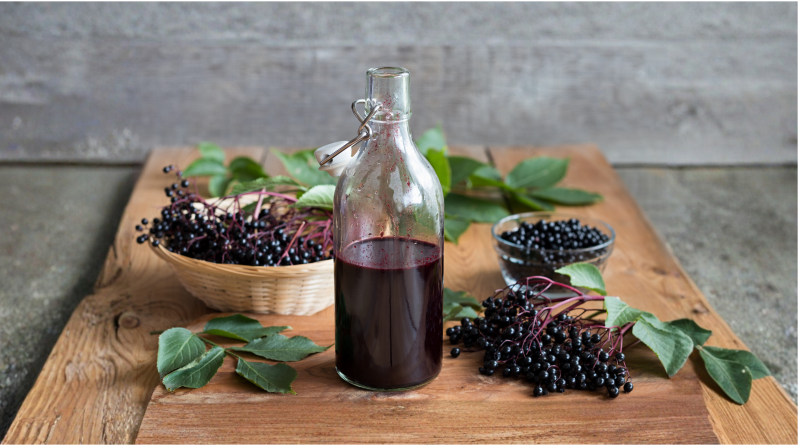
School is starting and you know what that means...new shoes, new backpacks, new teachers, new schedules, and new school supplies that somehow require approximately 900 pencils, 14 boxes of tissues, and enough glue sticks to repair the Space Shuttle.
And let's not forget...new germs.
Every fall we send our children off to this quaint little place called school aka the petri dish. Our little darlings flock together, breathe the same air, touch the same things, and then come home and hug everybody. The spread of the ick begins.
It's basically a biological group project.
If you've been around the natural-remedy world for more than five minutes, you've probably heard about elderberry. It's in syrups, teas, gummies, and capsules. It's probably hiding in somebody's purse right now. But here's what caught our attention: Elderberry isn't some newfangled wellness fad. People have been using this little purple berry for a very, very long time.
Dig into its history, where it grows, how it's traditionally prepared, and what modern research has to say about it, and elderberry starts looking less like the latest health-food celebrity and more like an old-fashioned pantry staple that somehow wandered into the 21st century.
So let's talk about it.
First, What Exactly Is an Elderberry?
Elderberries come from plants in the Sambucus family. One of the best-known species is the European black elderberry, Sambucus nigra. North America has its own native elderberry varieties as well. The plants are shrubs that produce clusters of tiny flowers, followed by clusters of berries. When those berries ripen, they turn a beautiful deep purple-black.
They're not particularly glamorous. They're not exotic. They're not something you have to order from a website that charges $37 for shipping because apparently the berries have to travel first class.
Elderberries grow in many parts of North America and Europe. They can be found around woodland edges, fields, streams, roadsides, and other areas with suitable moisture and sunlight.
Elderberry Has History
This is where elderberry gets interesting.
People didn't suddenly discover it after someone decided purple foods were having a moment. The European elder has been used for thousands of years, and elderberry has a long history in traditional food and herbal practices. Native Americans also used native elderberry varieties for food and traditional purposes.
Different parts of the plant have been used in different ways, most notably the flowers and berries. The berries have been made into foods and beverages, while traditional preparations have included syrups, teas, wines, jellies, jams, and pies.
In other words, somebody a very long time ago looked at this shrub and thought:
“Hmm. I wonder what I can do with that?”
And here we are.
From Flower to Fruit
Elderberry begins its annual performance with flowers. Depending on the variety and location, those flowers can appear in spring and early summer. Eventually, those clusters develop into berries.
The timing varies depending on where the plant is growing. In Florida, native elderberries can flower early in the year, with fruit potentially ripening as early as June. Farther north, the berries may ripen later, with harvesting commonly taking place during the summer and into early fall.
The berries should be fully ripe before they're harvested. And that is not a minor detail. We're talking fully ripe. Not “they're mostly purple.” Not “they'll probably be fine.” Not “I watched a YouTube video.” Fully ripe because elderberries are one of those plants where knowing what you're doing matters.


Elderberry Is Not a Grab-and-Eat Berry
Here's where we have to put on our serious face for approximately thirty seconds.
Raw or unripe elderberries can cause nausea, vomiting, diarrhea, and other unpleasant symptoms. The leaves and stems also contain compounds that can be harmful if consumed.
Proper cooking makes the ripe berries suitable for consumption.
So if you happen to have an elderberry bush growing nearby, please don't wander outside and start eating berries off it like you're a woodland creature. Elderberry is not a “when in doubt, pop it in your mouth” kind of plant. If you're harvesting wild elderberries, you need to correctly identify the plant and make sure you're working with ripe fruit. If you're not absolutely certain? Leave the berries alone. Your digestive system will appreciate the restraint.
So Why Elderberry Syrup?
Now we're getting to the good stuff.
One of the traditional ways elderberries have been used is in syrup. Honestly, syrup makes a lot of sense.
Elderberries aren't exactly the sort of fruit you grab by the handful and snack on while watching television. They're small. They're seedy. They're tart. And raw, they're not something you want to be eating anyway. But cook those berries down with other ingredients and you've got something entirely different. A concentrated, spoonable syrup that can be stored and used in small amounts?
Now we're talking.
Traditional elderberry syrups often combine cooked elderberries with ingredients such as honey, spices, ginger, or other botanicals.
Why has elderberry syrup has remained popular? It's practical. It's easy to incorporate into a routine.
And, unlike swallowing a giant capsule that feels like you're trying to pass a marble through your esophagus, syrup is relatively pleasant especially when honey and warming spices are involved.
But Does Elderberry Actually Do Anything?
We'd love to tell you that elderberry is the answer to every sniffle, sneeze, cough, and school-bus-induced plague. But we're not going to.
There is some scientific evidence suggesting elderberry may help reduce the duration or severity of certain upper-respiratory symptoms, including symptoms associated with colds and influenza.
But the research isn't conclusive as it depends on who is doing the research, what they're seeking to prove or disprove, testing methods, the inherent difference in test subjects, and a ton of other factors. Simply put...it's complicated.
Some studies have found benefits while others haven't. Researchers have pointed out that more high-quality studies are needed.
So elderberry is promising. It is not magic. There is a difference. And frankly, we'd rather give you the truth than make a dramatic claim just because dramatic claims sell more bottles.


So What Makes Elderberries Interesting?
For starters, elderberries contain anthocyanins. Those are naturally occurring plant pigments responsible for the deep red, blue, and purple colors found in many fruits and vegetables associated with antioxidant activity. Elderberries contain other polyphenolic compounds as well.
That doesn't mean eating elderberry syrup turns you into an indestructible health machine. If it did, we'd all be taking shots of elderberry syrup and challenging the school nurse to a duel. But it does make elderberries an interesting addition to the list of traditional foods and botanicals worth knowing about. That's really the point. We're not looking for a miracle. We're looking for useful.
The Pantry-Ready Approach
There's something wonderfully old-fashioned about having a bottle of homemade elderberry syrup tucked into the refrigerator. It feels like something Grandma would have made. Not because Grandma had a PhD in pharmacology. Because Grandma knew that sometimes you take what nature gives you, learn how to prepare it properly, and keep a little on hand.
Today, we have more options. You can buy commercial elderberry syrups. You can buy dried elderberries. You can buy elderberry extracts. Or, if you're the type who likes knowing exactly what goes into the things your family uses, you can make your own syrup, and that's where elderberry gets particularly interesting for the modern pantry.
Making elderberry syrup doesn't require a laboratory. It requires good ingredients, proper preparation, a little patience, and the willingness to follow directions instead of deciding halfway through that “close enough” is a perfectly acceptable measurement system. This is not the time for the person who cooks by throwing things into a pot and saying, “Eh... that's probably a teaspoon.” (We know who you are.)
And Yes, You Can Make It Yourself
This is one of the things we love about elderberry. It's approachable. You don't need a fancy machine. You don't need a chemistry degree. You don't need to order ingredients from the other side of the planet. You can start with dried elderberries and build a traditional-style syrup right in your own kitchen. Once you understand what you're doing, it becomes one of those wonderfully practical little homemade preparations that you can keep around when the seasons change.
That's also why we're particularly fond of the idea of an elderberry syrup making kit. Because sometimes the biggest obstacle to making something yourself isn't the actual process. It's figuring out what on earth you're supposed to buy. How much? Which ingredients? What kind? What do I do with them? And why did I just spend forty-five minutes wandering around the internet reading seventeen contradictory recipes?
A good kit takes some of that nonsense out of the equation. Everything is gathered together. You know what you're working with. You can actually make the thing instead of spending three days preparing to make the thing. Which, let's be honest, is how a lot of our “I'll make that myself” projects go to the point they never get completed.

Elderberry Isn't a Cure-All—and That's Okay
We're not going to tell you elderberry will prevent every illness that walks through your front door. We're not going to tell you it replaces medical treatment. We're not going to tell you to skip your doctor's advice because somebody on Facebook swears elderberry cured their cousin's neighbor.
Nope.
What we will say is that elderberry has a fascinating history, a legitimate place in traditional herbal practices, interesting nutritional compounds, and enough preliminary scientific evidence to make researchers keep looking at it.
That's pretty darn interesting for a little purple berry.
And when something has been used for generations, is relatively accessible, can be prepared at home, and fits nicely into a traditional pantry approach to wellness?
We think it's worth knowing about.
So, Should Elderberry Be in Your Pantry?
Well...
If you're the person who likes to have chicken soup before you're sick instead of after you're sick, keeps extra batteries because the flashlight will inevitably die during a power outage, and buys toilet paper before you're down to one roll...you may be our kind of person. Elderberry might fit right in.
The goal isn't to live in fear of every germ that comes through the front door. The goal is to be prepared, and August is actually a pretty good time to think about it. The school buses are coming. The backpacks are coming. The first classroom cough is coming. Somebody is going to sneeze on something they absolutely should not sneeze on. It's inevitable.
So maybe this is the year you learn a little more about elderberry. Maybe you try a commercial syrup. Maybe you learn to make your own. Maybe you decide to keep a bottle in the refrigerator right alongside the mustard, pickles, and whatever leftovers nobody is admitting belong to them. Either way, there's something satisfying about bringing an old-fashioned remedy back into a modern kitchen. Because sometimes Grandma wasn't wrong. She just didn't have a Wi-Fi connection to tell everybody about it.
Coffee on. Chaos managed. ☕
Add comment
Comments